
Our faculty has structured the department to have strong coverage in our five core areas:
Within these areas, our faculty work on a wide range of topics in economics important to the country and the world. Some of our most impactful work focuses on the US and global financing system, how unemployment affects workers and the economy, causes and consequences of economic inequality and poverty, household economic choices and economic behavior, and the importance of game theory and political economy to understanding economic outcomes.
By focusing on these five core areas, particularly at the graduate level, the department offers a unique, specific educational experience. Aside from traditional coursework, research, and special lectures, the department holds three weekly seminars to encourage collaboration and communication within these five disciplines.
Research Highlights
-

The Prestakes of Stock Market Investing
Research Area: FinanceHow rational is the stock market and how efficiently does it process information? We use machine learning to establish a practical measure of rational and efficient expectation formation while identifying distortions and inefficiencies in the subjective beliefs of market participants. The algorithm independently learns, stays attentive to fundamentals, credit risk, and sentiment, and makes abrupt…
-

Market Structure, Investment, and Technical Efficiencies in Mobile Telecommunications
Research Area: Applied MicroeconomicsWe develop a model of competition in prices and infrastructure among mobile network operators. Although consolidation increases market power, it can lead to more efficient data transmission due to economies of scale, which we derive from physical principles. After estimating our model with French consumer and infrastructure data, equilibrium simulations reveal that while prices decrease…
-

Mandatory vs. Discretionary Spending: The Status Quo Effect
Research Area: EconometricsDo mandatory spending programs such as Medicare improve efficiency? We analyze a model with two parties allocating a fixed budget to a public good and private transfers each period over an infinite horizon. We compare two institutions that differ in whether public good spending is discretionary or mandatory. We model mandatory spending as an endogenous…
-
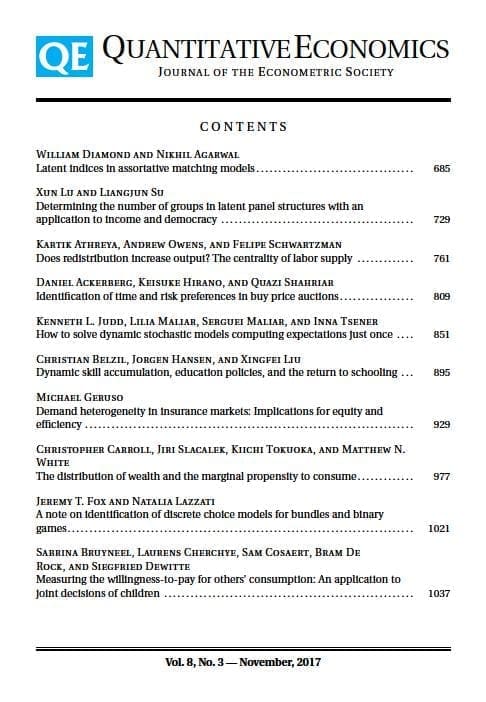
The Distribution of Wealth and the Marginal Propensity to Consume
Research Area: Economic theoryIn a model calibrated to match micro- and macroeconomic evidence on household income dynamics, we show that a modest degree of heterogeneity in household preferences or beliefs is sufficient to match empirical measures of wealth inequality in the United States. The heterogeneity-augmented model’s predictions are consistent with microeconomic evidence that suggests that the annual marginal…
-
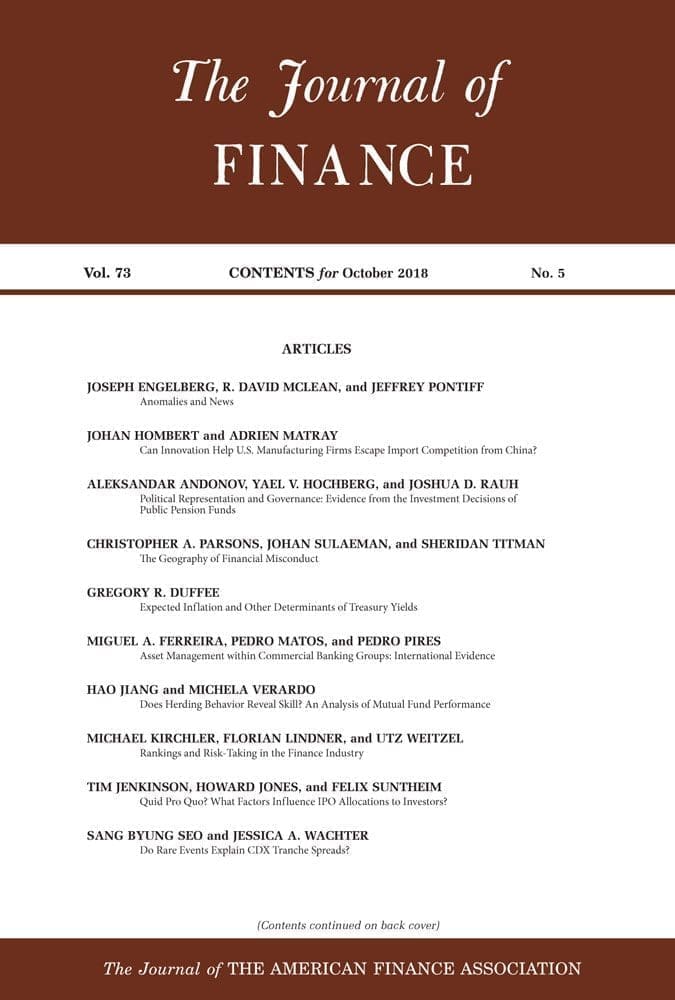
Expected Inflation and Other Determinants of Treasury Yields
Research Area: FinanceShocks to nominal bond yields consist of news about expected future inflation, expected future real short rates, and expected excess returns—all over the bond’s life. I estimate the magnitude of the first component for short- and long-maturity Treasury bonds. At a quarterly frequency, variances of news about expected inflation account for between 10% to 20%…
-
A Mechanism for Eliciting Second-Order Beliefs and the Inclination to Choose
Research Area: EconometricsThis paper describes a direct revelation mechanism for eliciting decision makers’ introspective beliefs on sets of subjective prior or posterior probabilities. The proposed scheme constitutes a revealed-preference procedure for measuring the inclination of decision makers to choose one alternative over another modeled by Minardi and Savochkin (2015).
-
Belief Distortions and Macroeconomic Fluctuations
Research Area: FinanceThis paper combines a data-rich environment with a machine learning algorithm to provide new estimates of time-varying systematic expectational errors (“belief distortions”) embedded in survey responses. We find sizable distortions even for professional forecasters, with all respondent-types overweighting the implicit judgmental component of their forecasts relative to what can be learned from publicly available information.…
-
Misclassification Errors In Labor Force Statuses and the Early Identification of Economic Recessions
Research Area: MacroeconomicsAccurate identification of economic recessions in a timely fashion is a major macroeconomic challenge. The so-called Sahm recession indicator (Sahm, 2019), one of the most reliable early detectors of the U.S. recessions, relies on changes in unemployment rates, and is thus subject to misclassification errors in labor force statuses based on survey data. We propose…
-
Missing Events in Event Studies: Identifying the Effects of Partially Measured News Surprises
Research Area: MacroeconomicsMacroeconomic news announcements are elaborate and multi-dimensional. We consider a framework in which jumps in asset prices around announcements reflect both the response to observed surprises in headline numbers and to latent factors, reflecting other news in the release. Non-headline news, for which there are no expectations surveys, is unobservable to the econometrician but nonetheless…