Our faculty has structured the department to have strong coverage in our five core areas:
Within these areas, our faculty work on a wide range of topics in economics important to the country and the world. Some of our most impactful work focuses on the US and global financing system, how unemployment affects workers and the economy, causes and consequences of economic inequality and poverty, household economic choices and economic behavior, and the importance of game theory and political economy to understanding economic outcomes.
By focusing on these five core areas, particularly at the graduate level, the department offers a unique, specific educational experience. Aside from traditional coursework, research, and special lectures, the department holds three weekly seminars to encourage collaboration and communication within these five disciplines.
Research Highlights
-

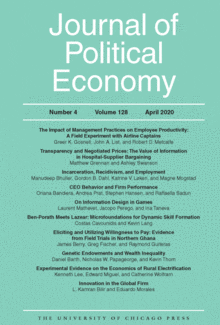
Genetic Endowments and Wealth Inequality
Research Area: Applied MicroeconomicsWe show that genetic endowments linked to educational attainment strongly and robustly predict wealth at retirement. The estimated relationship is not fully explained by flexibly controlling for education and labor […]
-

Bargaining and News
Research Area: FinanceWe study a bargaining model in which a buyer makes frequent offers to a privately informed seller, while gradually learning about the seller’s type from “news.” We show that the […]
-

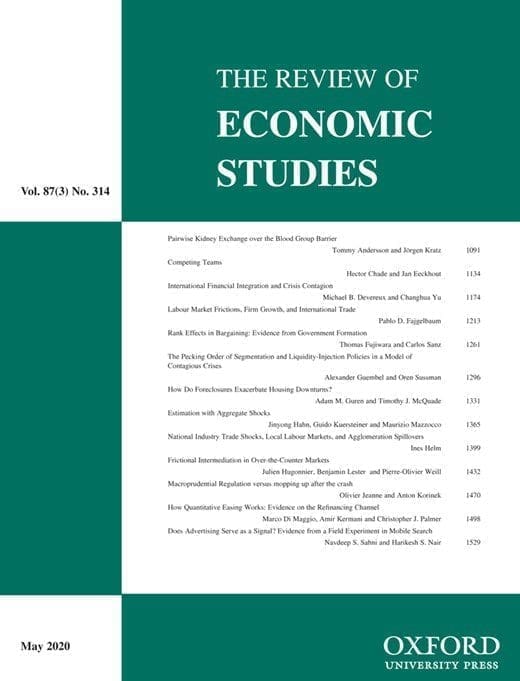
Macroprudential Regulation Versus Mopping Up After the Crash
Research Area: FinanceHow should macroprudential policy be designed when policymakers also have access to liquidity provision tools to manage crises? We show in a tractable model of systemic banking risk that there […]
-

Understanding U.S. Inflation During the COVID Era
Research Area: FinanceThe paper summarized here is part of the Fall 2022 edition of the Brookings Papers on Economic Activity (BPEA), the leading conference series and journal in economics for timely, cutting-edge […]
-

Diagnostic Business Cycles
Research Area: FinanceA large psychology literature argues that, due to selective memory recall, decision-makers’ forecasts of the future are overly influenced by the perceived news. We adopt the diagnostic expectations (DE) paradigm […]
-

Designing Securities for Scrutiny
Research Area: FinanceWe investigate the effect of scrutiny (e.g., credit ratings, analyst reports, or mandatory disclosures) on the security design problem of a privately informed issuer. We show that scrutiny has important […]
-

Threats to Central Bank Independence: High-Frequency Identification with Twitter
Research Area: FinanceA high-frequency approach is used to analyze the effects of President Trump’s tweets that criticize the Federal Reserve on financial markets. Identification exploits a short time window around the precise […]
-

Hybrid Decision Model and the Ranking of Experiments
Research Area: Economic theoryDeparting from the reduction of compound lotteries axiom on multi-stage lotteries, this paper proposes a new hybrid model to analyze decision trees. Applied to multi-stage decision trees induced by experiments, […]
-

The Supplemental Expenditure Poverty Measure: A New Method for Measuring Poverty
Research Area: MacroeconomicsA new method of measuring poverty in the United States—based on families’ spending and easily accessible resources—finds that about eight million more people lived in poverty in 2019 than reported […]