
Our primary faculty research groups are focused in our five core areas: applied microeconomics, econometrics, economic theory, finance, and macroeconomics. Our joint faculty includes experts from the Carey Business School and the School of Advanced International Studies.
Finance Group
Coverage includes: applied and theoretical finance, bankruptcy, corporate re-structuring, financial econometrics, financial regulation, fixed income securities, sovereign lending
- Faculty: Brendan Daley, Greg Duffee, Olivier Jeanne, Jonathan Wright
- Jointly Appointed Faculty: Alessandro Rebucci (Carey Business School)
- Undergraduate minor in financial economics offered in conjunction with the Center for Financial Economics
-

The Prestakes of Stock Market Investing
How rational is the stock market and how efficiently does it process information? We use machine learning to establish a practical measure of rational and efficient expectation formation while identifying distortions and inefficiencies in the subjective beliefs of market participants. The algorithm independently learns, stays attentive to fundamentals, credit risk, and sentiment, and makes abrupt…
-
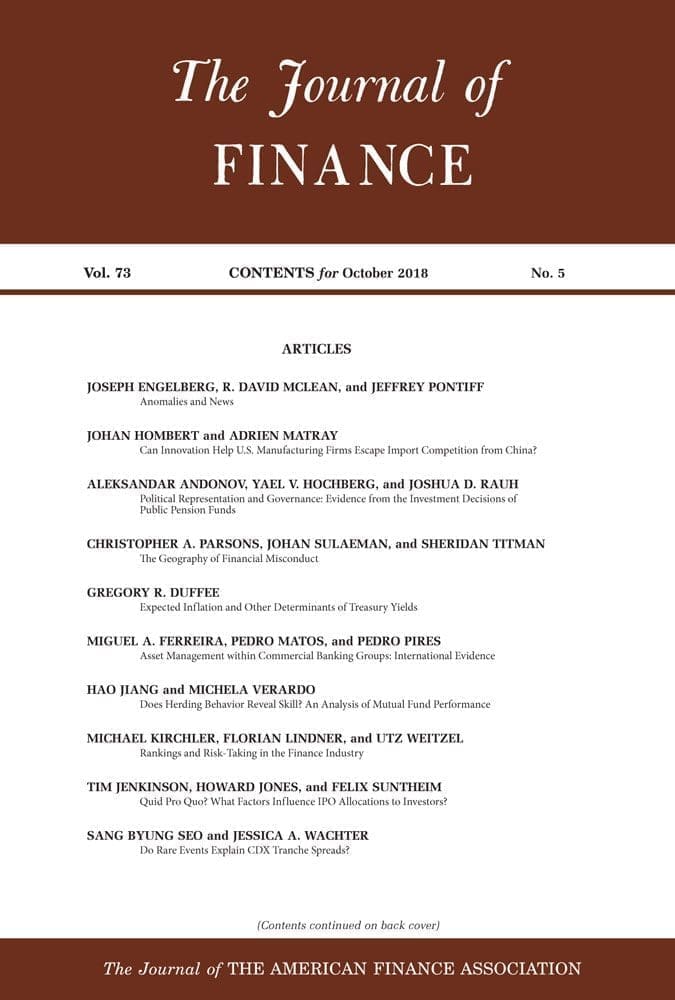
Expected Inflation and Other Determinants of Treasury Yields
Shocks to nominal bond yields consist of news about expected future inflation, expected future real short rates, and expected excess returns—all over the bond’s life. I estimate the magnitude of the first component for short- and long-maturity Treasury bonds. At a quarterly frequency, variances of news about expected inflation account for between 10% to 20%…
-

Belief Distortions and Macroeconomic Fluctuations
This paper combines a data-rich environment with a machine learning algorithm to provide new estimates of time-varying systematic expectational errors (“belief distortions”) embedded in survey responses. We find sizable distortions even for professional forecasters, with all respondent-types overweighting the implicit judgmental component of their forecasts relative to what can be learned from publicly available information.…
-
Bargaining and News
We study a bargaining model in which a buyer makes frequent offers to a privately informed seller, while gradually learning about the seller’s type from “news.” We show that the buyer’s ability to leverage this information to extract more surplus from the seller is remarkably limited. In fact, the buyer gains nothing from the ability…
-
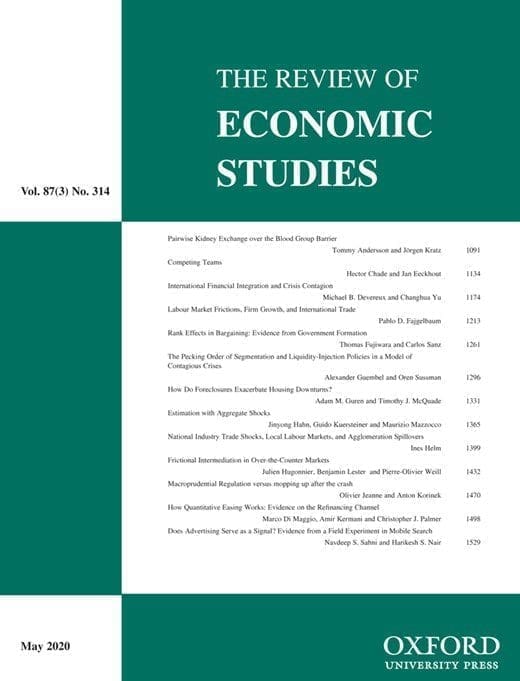
Macroprudential Regulation Versus Mopping Up After the Crash
How should macroprudential policy be designed when policymakers also have access to liquidity provision tools to manage crises? We show in a tractable model of systemic banking risk that there are three factors at play: first, ex post liquidity provision mitigates financial crises, and this reduces the need for macroprudential policy. In the extreme, if…
-

Understanding U.S. Inflation During the COVID Era
The paper summarized here is part of the Fall 2022 edition of the Brookings Papers on Economic Activity (BPEA), the leading conference series and journal in economics for timely, cutting-edge research about real-world policy issues. The conference draft of this paper was presented at the Fall 2022 BPEA conference. The final version was published in…